About Pathways
What Are Math Pathways?
What are math pathways? In short:
Mathematics pathways refer to the course or the sequence of courses that students take to meet credit or program requirements and to prepare them to use mathematics for their careers, for making sense of the world, and for their own sense of enjoyment and empowerment.
Typically, discussions of mathematics pathways focus on the courses students take as they progress through secondary (high school) and postsecondary education (college or other career training) and how the availability of multiple pathway options allows students to take advantage of opportunities best suited to their unique needs.
The Common High School Pathway
Many high schools have some sequence of courses leading to calculus that looks like this:

Or, more accurately, high schools usually have some version of this:
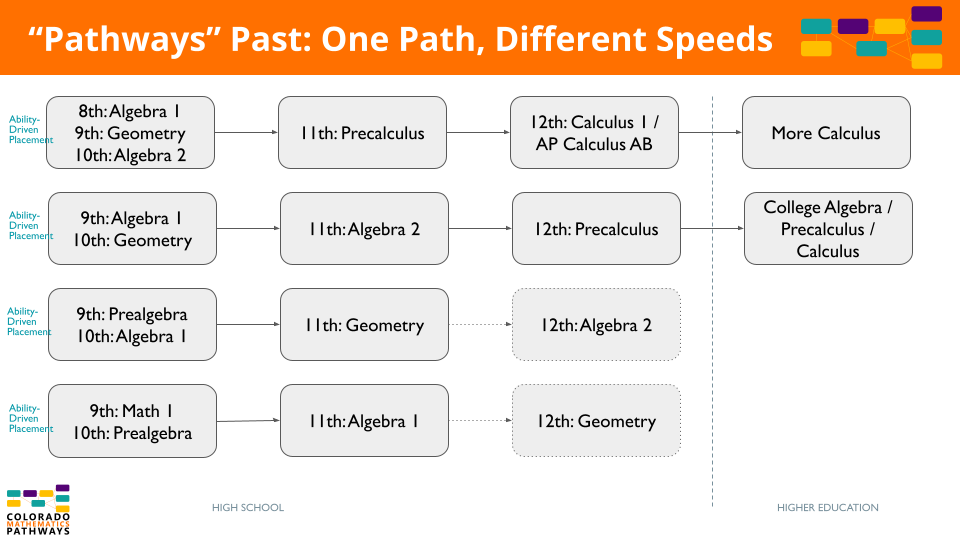
Increased access to calculus has been one of the great achievments in high school mathematics over the past 40 years. Calculus is a powerful tool, and is required for most students pursuing a future in a STEM degree or career. However, only 10 to 15 percent of our students might earn STEM degrees. Are there other mathematics options worth considering for the vast majority of students pursing something else? Many people think so.
Math Pathways in Other States
Mathematics pathways have been a focus of national and state conversations now for over 10 years, including here in Colorado. Here are snapshots of pathways in other states.
Oregon
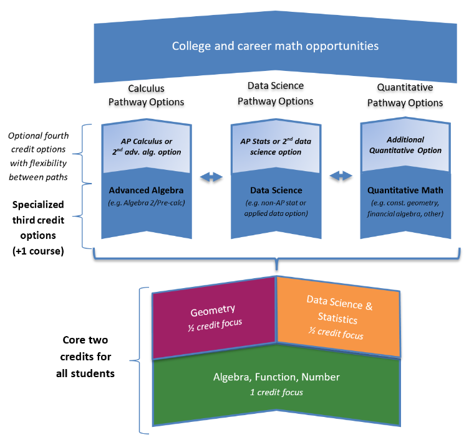
Oregon's "2+1" course design places common expectations for all students to study a year of algebra, a semester of geometry, and a semester of statistics as the "core credits." Beyond those two credits, students can choose a pathway for their required third credit, which could be advanced algebra, data science, or a quantitative reasoning course. Elective options beyond the third course are available, each leading students towards a calculus pathway, a data science pathway, or a quantiatitve pathway.
Washington
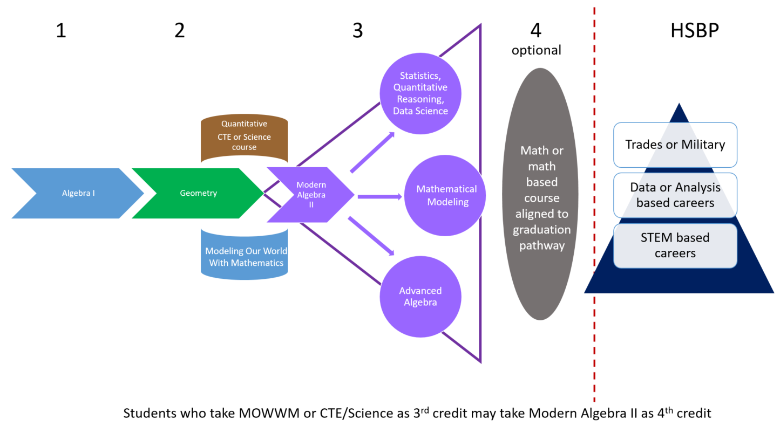
Washinton's "Modern Algebra II" model requires students to take common Algebra 1 and Geometry courses and then partway through Algebra 2, students have the option of choosing a path directed towards statistics, mathematical modeling, or advanced algebra.
Ohio
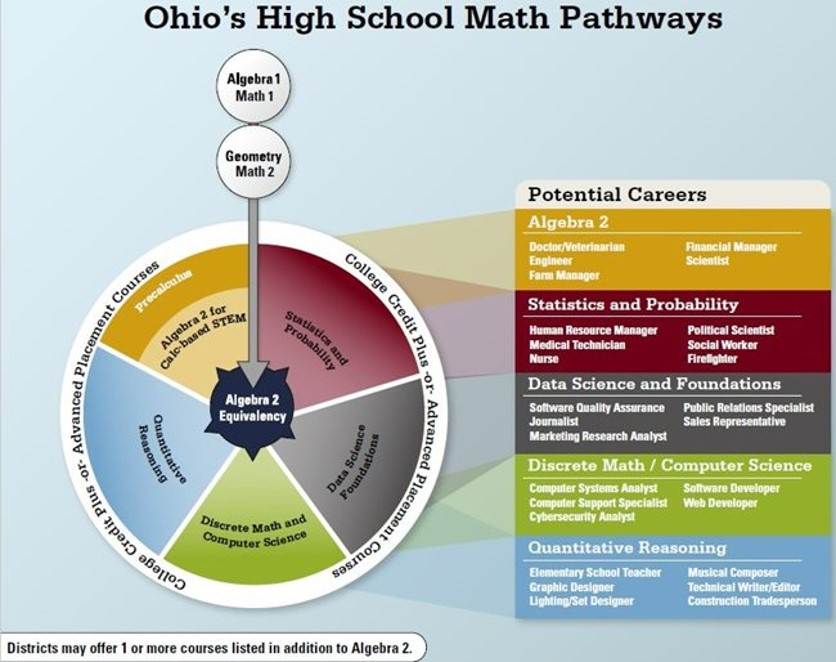
Ohio's pathway model requires common Algebra 1 and Geometry courses (or Math 1 and Math 2), and then a third year consisting of Algebra 2 or an equivalent. From there, up to five different paths exist for students, including options like discrete math and computer science, quantiative reasoning, and data science foundations.
Alabama
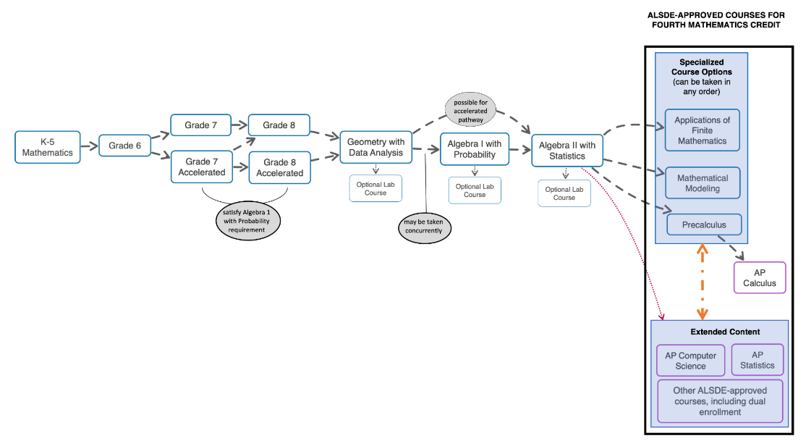
Alabama's pathways include the expectation that all 9th graders take a year of geometry and data analysis. From there, most students move to Algebra I or Algebra II before getting "specialized course options" including Applications of finite mathematics, mathematical modeling, or precalculus. Notable in Alabama's pathways are the lab courses that offer students extra support in the high school courses, and the option to take Goemetry and Algebra 1 together in high school to accelerate one year.
Resources
Books
Leinwand, S., & Milou, E. (2021). Invigorating high school math: Practical guidance for long-overdue transformation. Heinemann. https://www.heinemann.com/products/e13416.aspx
National Council of Teachers of Mathematics. (2018). Catalyzing change in high school mathematics: Initiating critical conversations. National Council of Teachers of Mathematics.
Steele, M. D., & Huhn, C. (2018). A quiet revolution: One district’s story of radical curricular change in high school mathematics. Information Age Publishing. https://www.infoagepub.com/products/A-Quiet-Revolution
Peer-Reviewed Journal Articles
Allensworth, E., Nomi, T., Montgomery, N., & Lee, V. E. (2009). College preparatory curriculum for all: Academic consequences of requiring algebra and English I for ninth graders in Chicago. Educational Evaluation and Policy Analysis, 31(4), 367–391. https://doi.org/10.3102/0162373709343471
Chávez, Ó., Tarr, J. E., Grouws, D. A., & Soria, V. M. (2015). Third-year high school mathematics curriculum: Effects of content organization and curriculum implementation. International Journal of Science and Mathematics Education, 13(1), 97–120. https://doi.org/10.1007/s10763-013-9443-7
Grouws, D. A., Tarr, J. E., Chávez, Ó., Sears, R., Soria, V. M., & Taylan, R. D. (2013). Curriculum and implementation effects on high school students’ mathematics learning from curricula representing subject-specific and integrated content organizations. Journal for Research in Mathematics Education, 44(2), 416–463. https://doi.org/10.5951/jresematheduc.44.2.0416
Jansen, A., Herbel-Eisenmann, B., & Smith III, J. P. (2012). Detecting students’ experiences of discontinuities between middle school and high school mathematics programs: Learning during boundary crossing. Mathematical Thinking and Learning, 14(4), 285–309. https://doi.org/10.1080/10986065.2012.717379
Krupa, E. E., & Confrey, J. (2017). Effects of a reform high school mathematics curriculum on student achievement: Whom does it benefit? Journal of Curriculum Studies, 49(2), 191–215. https://doi.org/10.1080/00220272.2015.1065911
Milou, E. (2020). The status quo is unacceptable. Mathematics Teacher: Learning and Teaching PK-12, 113(10), e51–e57. https://doi.org/10.5951/MTLT.2019.0059
Tarr, J. E., Grouws, D. A., Chávez, Ó., & Soria, V. M. (2013). The effects of content organization and curriculum implementation on students’ mathematics learning in second-year high school courses. Journal for Research in Mathematics Education, 44(4), 683–729. https://doi.org/10.5951/jresematheduc.44.4.0683
Usiskin, Z. (2020). Then: The timing of Algebra 1. Mathematics Teacher: Learning and Teaching PK-12, 113(6), 524–526. https://doi.org/10.5951/MTLT.2019.0394
Book Chapters
Allen-Fuller, K., Robinson, M., & Robinson, E. (2010). Curriculum as a change agent: High schools that rise to the challenge and what they stand to gain. In B. J. Reys, R. E. Reys, & R. Rubenstein (Eds.), Mathematics curriculum: Issues, trends, and future directions: Seventy-second yearbook (pp. 231–246). National Council of Teachers of Mathematics.
Reports and White Papers
Burdman, P. (2013). Changing equations: How community colleges are re-thinking college readiness in math (p. 24). LearningWorks. http://www.learningworksca.org/changingequations/
Burdman, P. (2015a). Diversifying math requirements for college readiness and graduation (Degrees of Freedom, p. 30). Policy Analysis for California Education. https://www.edpolicyinca.org/publications/degrees-freedom-diversifying-math-requirements-college-readiness-and-graduation-report
Burdman, P. (2015b). Varying routes to math readiness and the challenge of intersegmental alignment (Degrees of Freedom, p. 32). Policy Analysis for California Education. https://www.edpolicyinca.org/publications/degrees-freedom-varying-routes-math-readiness-and-challenge-intersegmental-alignment
Burdman, P. (2015c). Probing math placement policies at california colleges and universities (Degrees of Freedom, p. 32). Policy Analysis for California Education. https://www.edpolicyinca.org/publications/degrees-freedom-probing-math-placement-policies-california-colleges-and-universities
Burdman, P. (2018a). Quantitative leap: How math policies can support transitions to and through college (p. 8). LearningWorks. http://www.learningworksca.org/quantitative-leap/
Burdman, P. (2018b). The mathematics of opportunity: Rethinking the role of math in educational equity (p. 32). Just Equations. https://justequations.org/resource/the-mathematics-of-opportunity-report/
Burdman, P., Booth, K., Thorn, C., Bahr, P. R., McNaughtan, J., & Jackson, G. (2018). Multiple Paths Forward: Diversifying Mathematics as a Strategy for College Success (p. 57). WestEd & Just Equations. https://justequations.org/resource/multiple-paths-forward-diversifying-math-pathways-as-a-strategy-for-student-success/
Daro, P. (2014). Oakland and San Francisco create course pathways through Common Core Mathematics (p. 10) [White paper]. Strategic Education Research Partnership (SERP). https://eric.ed.gov/?id=ED564483
Daro, P., & Austurias, H. (2019). Branching out: Designing high school math pathways for equity (p. 28). Just Equations. https://justequations.org/resource/branching-out-designing-high-school-math-pathways-for-equity/
Finkelstein, N., Tiffany-Morales, J., & Shields, P. M. (2012). College bound in middle school and high school? How math course sequences matter (p. 52). The Center for the Future of Teaching and Learning at WestEd. https://www.wested.org/resources/college-bound-in-middle-school-and-high-school-how-math-course-sequences-matter/
Fitzpatrick, L., Kung, D., Ledoux, S., May, S., Smith Arrillaga, E., Chandler, J., O’Hara, M., Reyna, R., Cole, S., Young, J., Alberti, S., Briggs, A., Cordova-Cobo, D., McKenna, R., Wilson, H., Coe, T., & Gonzalez, V. (2022). Re-envisioning mathematics pathways to expand opportunities (p. 54). The Charles A. Dana Center at The University of Texas at Austin, Education Strategy Group, and Student Achievement Partners. https://edstrategy.org/resource/re-envisioning-mathematics-pathways-to-expand-opportunities/
National Council of Teachers of Mathematics. (2019). Work to end tracking and offer four years of meaningful math instruction (A Case Study in Catalyzing Change in High School Mathematics, p. 2). National Council of Teachers of Mathematics. https://www.nctm.org/uploadedFiles/Standards_and_Positions/San-Francisco-Unified-School-District-Work-to-End-Tracking-and-Offer-Four-Years-of-Meaningful-Math-Instruction.pdf
Position Papers
Association of State Supervisors of Mathematics. (2021). Detracking school mathematics to ensure equitable and empowering programs and opportunities (p. 9) [Position Statement]. Association of State Supervisors of Mathematics. https://assm.wildapricot.org/Position-Statements
MAA & NCTM. (2012). Calculus: A joint position statement of the Mathematical Association of America and the National Council of Teachers of Mathematics (p. 2) [Position Statement]. Mathematical Association of America and National Council of Teachers of Mathematics. https://www.nctm.org/Standards-and-Positions/Position-Statements/Calculus/
News Articles
Baker, M. (2022, October 31). Calculus is seen as a proxy for high-achieving students. That’s a problem. Chalkbeat. https://www.chalkbeat.org/2022/10/31/23427547/calculus-statistics-college-admissions
Sawchuk, S. (2018, June 13). A bold effort to end algebra tracking shows promise. Education Week. https://www.edweek.org/teaching-learning/a-bold-effort-to-end-algebra-tracking-shows-promise/2018/06
Opinions and Editorials
Berry III, R. Q. (2019, December). Let’s talk about mathematics pathways. President’s Message. https://www.nctm.org/News-and-Calendar/Messages-from-the-President/Archive/Robert-Q_-Berry-III/Lets-Talk-About-Mathematics-Pathways/
Boaler, J., & Levitt, S. D. (2019, October 23). Opinion: Modern high school math should be about data science—Not Algebra 2. Los Angeles Times. https://www.latimes.com/opinion/story/2019-10-23/math-high-school-algebra-data-statistics
Larson, M. D. (2016, October 25). Bringing needed coherence and focus to high school mathematics. President’s Message. https://www.nctm.org/News-and-Calendar/Messages-from-the-President/Archive/Matt-Larson/Bringing-Needed-Coherence-and-Focus-to-High-School-Mathematics/
Leinwand, S. (2014, August 2). We reallly need to revise the 9-12 Common Core Math Standards. Steve Leinwand. http://steveleinwand.com/we-reallly-need-to-revise-the-9-12-common-core-math-standards/
Mathews, J. (2019, December 15). Algebra II just doesn’t add up when you figure how little it means to most students. Washington Post. https://www.washingtonpost.com/local/education/algebra-ii-just-doesnt-add-up-when-you-figure-how-little-it-means-to-most-students/2019/12/15/1fabc4e8-1c7f-11ea-8d58-5ac3600967a1_story.html
Rockmore, D. (2020, September 26). Should high schools teach data science instead of calculus? Salon. https://www.salon.com/2020/09/26/teaching-data-science-instead-of-calculus-high-schools-math-debate/